
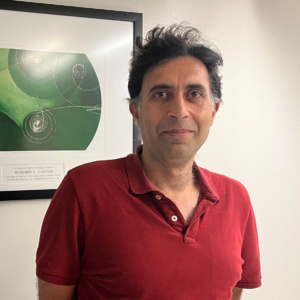
Amin Aminaei has a background in radio-frequency engineering and astronomy. Radio-frequency engineering is a subset of electronic engineering involving the application of transmission line, waveguide, antenna and electromagnetic field principles to the design and application of devices that produce or utilize signals within the radio band. As a Brinson Fellow, Aminaei applies this unique expertise to the Dark E-field Radio experiment, specially designed by Tony Tyson to detect the electromagnetic signals of the dark photons, one of the primary candidates for dark matter. The search for electromagnetic signals in the experiment covers the MHz and GHz (microwave) frequency spectrum. In this position, Aminaei primarily works on the lab setup for the microwave band. An initial paper on the details of the experiment was published in 2021. Prior to this Fellowship position, Aminaei worked at the Netherlands Institute for Space Research (SRON) where he was a team member of the SPICA/SAFARI (a mission concept for the Space Infrared Telescope for Cosmology and Astrophysics). From 2016-2018, while at the University of Oxford, UK, he contributed to the development of digital systems for the Square Kilometer Array (SKA), the world’s largest radio telescope to be built in Australia and South Africa. Aminaei held a postdoctoral and technical engineer position at Radboud University in the Netherlands from 2009-2015 where he helped develop and install the Auger Engineering Radio Array (AERA) that sits in the field of Pierre Auger Observatory in Argentina. AERA detects the radio emission of extensive air shower caused by ultra-high energy cosmic rays (UHECR). At Radboud he was also a team member responsible for developing the Lunar Radio eXplorer (LRX, Phase-A study), an instrument planned for the ESA lunar mission for radio astronomy on the Moon’s surface. In 2020, Aminaei was awarded third prize for the NASA Ideation Challenge for designing a miniature ultra-wideband Ground Penetrating Radar for the lunar Artemis Program.
Amin Aminaei
Written by
in